
You have been carrying something for years that nobody sees.
This is not a holiday.
It is not a tour.
You bring something with you. Something you have carried for a long time and mostly stopped noticing, because it belongs to you like the pack on your back.
For fifteen days we unpack it together. Piece by piece, at your pace, far away from everything that usually holds you in place. And you decide for yourself what goes back in and what stays in Nepal.
You take tools home that also work on a Tuesday morning and not only on a mountain ridge. That is the difference between a beautiful memory and a change.
And somewhere in the middle of it, usually on a day nobody planned anything special, you will get an answer to a question you have been carrying for years.
This is not a hike with a bit of programme around it either. That is why the group stays small, and why we talk before anything else.
That is why there is no booking button on this page. We talk first. If it is not right for you, I will say so, and that is a good outcome too.
The journey begins before you fly
The fifteen days in Nepal are the middle part. What happens before and after decides whether this becomes a change or only a beautiful memory.
You get clear on why you are going
A one to one session with me, sixty minutes. It is not about equipment, it is about the one question: why now? What are you looking for, and what do you want to put down? You set out with that question, and it is the one we measure against at the end.
Plus one evening together for everyone travelling: route, equipment, vaccinations, food, everything you want to know. And you meet each other there instead of seeing each other for the first time at the airport.
As soon as you are in, you join the group of participants. From that point on you are never alone with a question.
You walk
Fifteen days, from the airport in Kathmandu back to the airport in Kathmandu. Kathmandu, a village, the Helambu, a monastery.
I walk the whole way with you and I am there every day for a conversation, planned or not. Usually the unplanned ones are the ones that matter.
“What I particularly value about Thorsten is his remarkable presence. In every session he is fully there, with all his energy and complete focus.”
Christian, Freiburg
What is inside these days is set out below, day by day. It is not a trek with a bit of programme.
You bring it home
A second one to one session once you are back. And that one is about the question most journeys fail on: how does what you understood in Nepal become your everyday life?
Not as a good intention, but as something you actually do on a Tuesday morning. You take tools home for that, tools that work at home.
And the people who walked with you stay. With no end date.
It is not a trek with a bit of programme
There is something in every day, and none of it is decoration. Some of it is in the plan. Some of it happens because the group is ready that evening.
A day in silence
A whole walking day without a word and without eye contact, in the Vipassana manner. In the evening a circle where people share. It is the half hour the whole day builds up to.
The fire ritual
At the highest point of the journey, with Langtang, Gosaikunda and Everest in front of you. You write down what you have been carrying, and you burn it. Perhaps you will need two lines. Perhaps half an hour. Both are right.
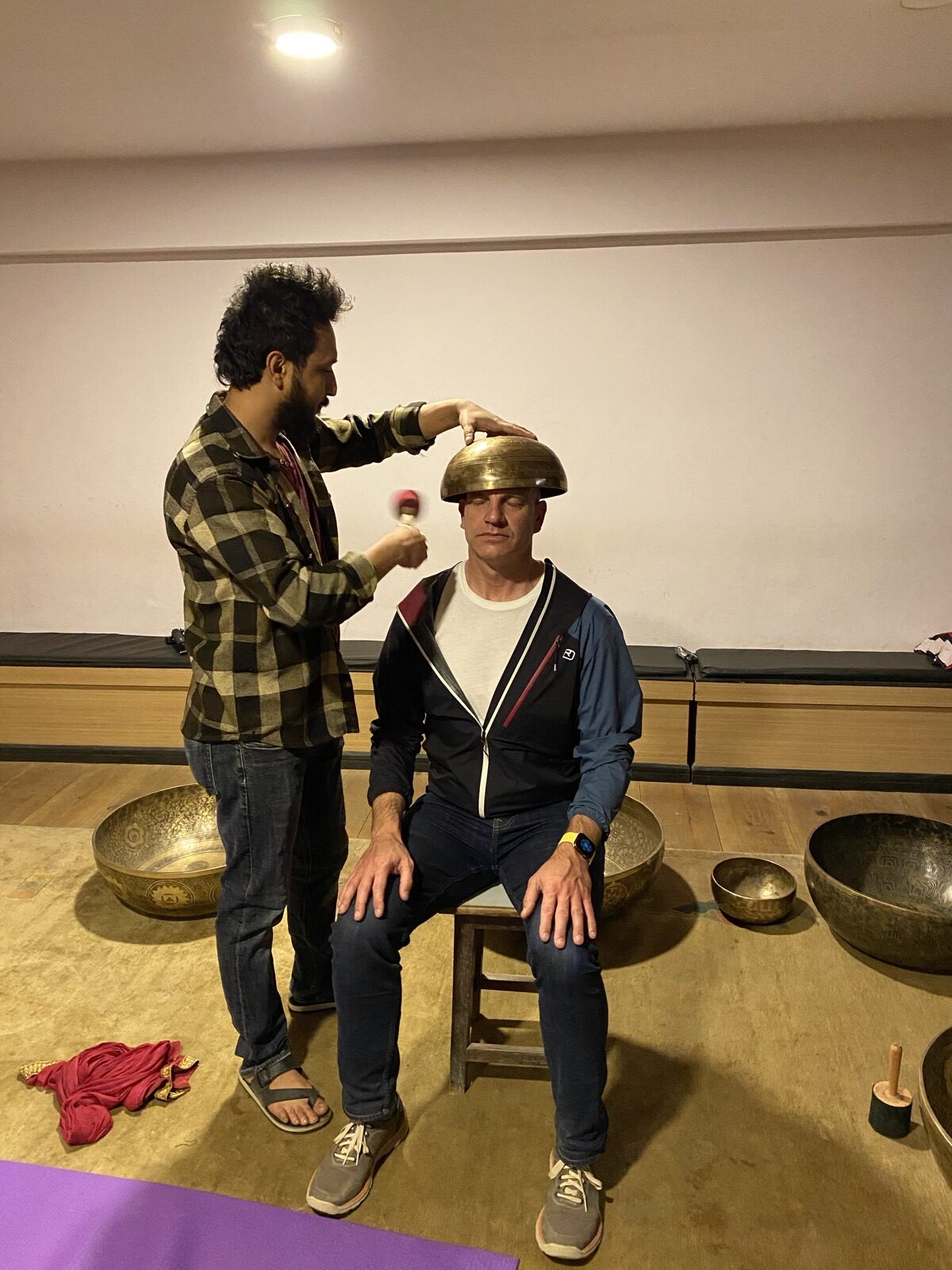
Singing bowls at 3,300 metres
An evening in the teahouse where nobody has to perform. It sounds esoteric. I thought so too, until I had done it.
Breathwork
When the group is ready. Not something in the plan so it can be ticked off, but something that fits the evening it fits.
Sacred places, and the people inside them
Swayambhunath at dusk, Pashupatinath with the sadhus, Boudhanath. Two nights in the monastery with puja before breakfast. You do not look at these places, you are inside them at half past five in the morning.
Conversations with no guidebook in between
With people who do not see you as a customer. That is the difference between visiting a country and being in one.
The Himalaya itself
Sunrise above the cloud line. Hours in which nobody says anything and nobody has to. Mountains do something to people that no seminar room can.
Culture you do not go and view
For three days you are part of a village and not a visitor in it. You work with them, you eat with them, you do not understand a word at dinner. For me this was the part that changed something. I have been sitting at these tables for years.
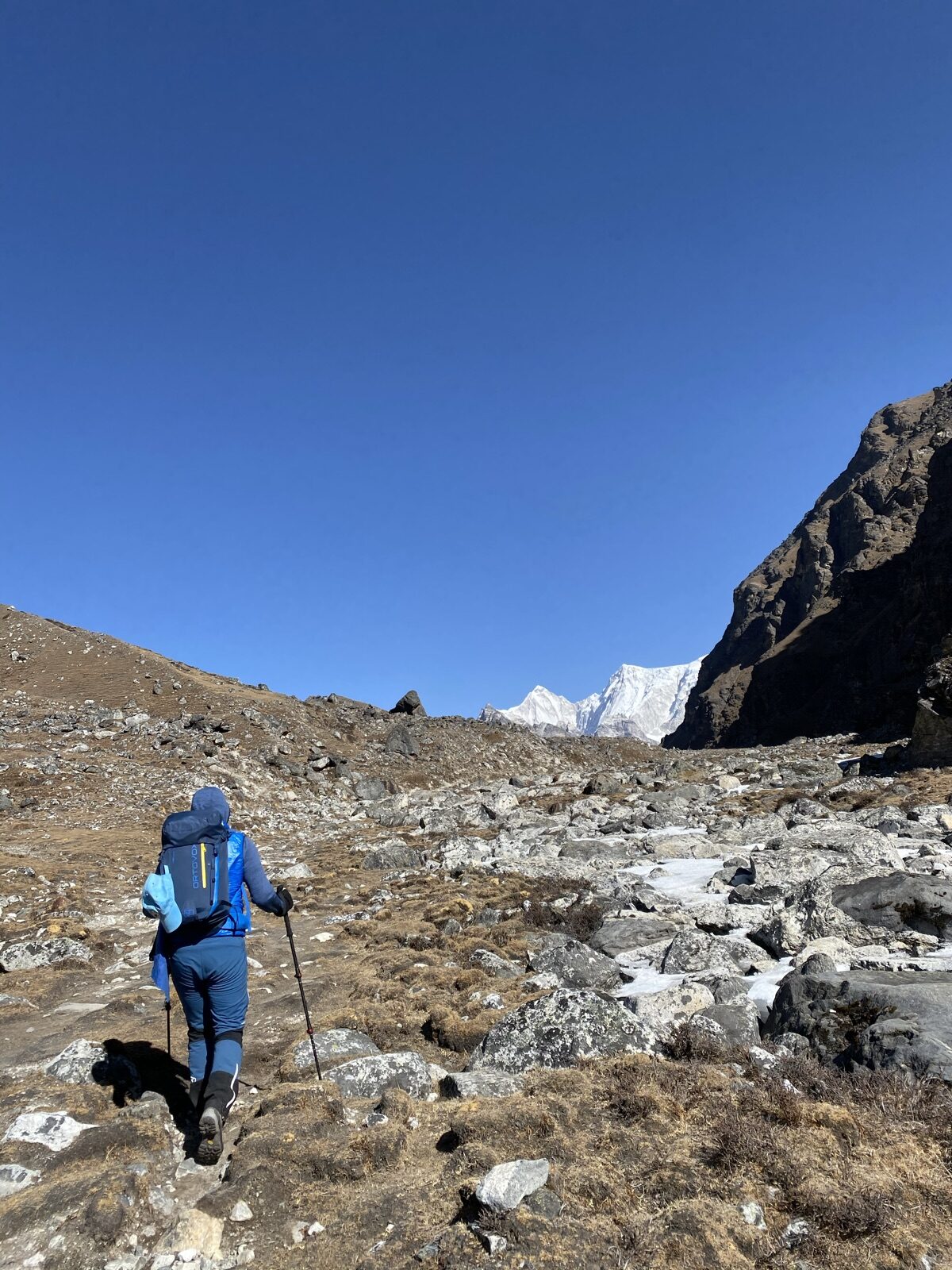
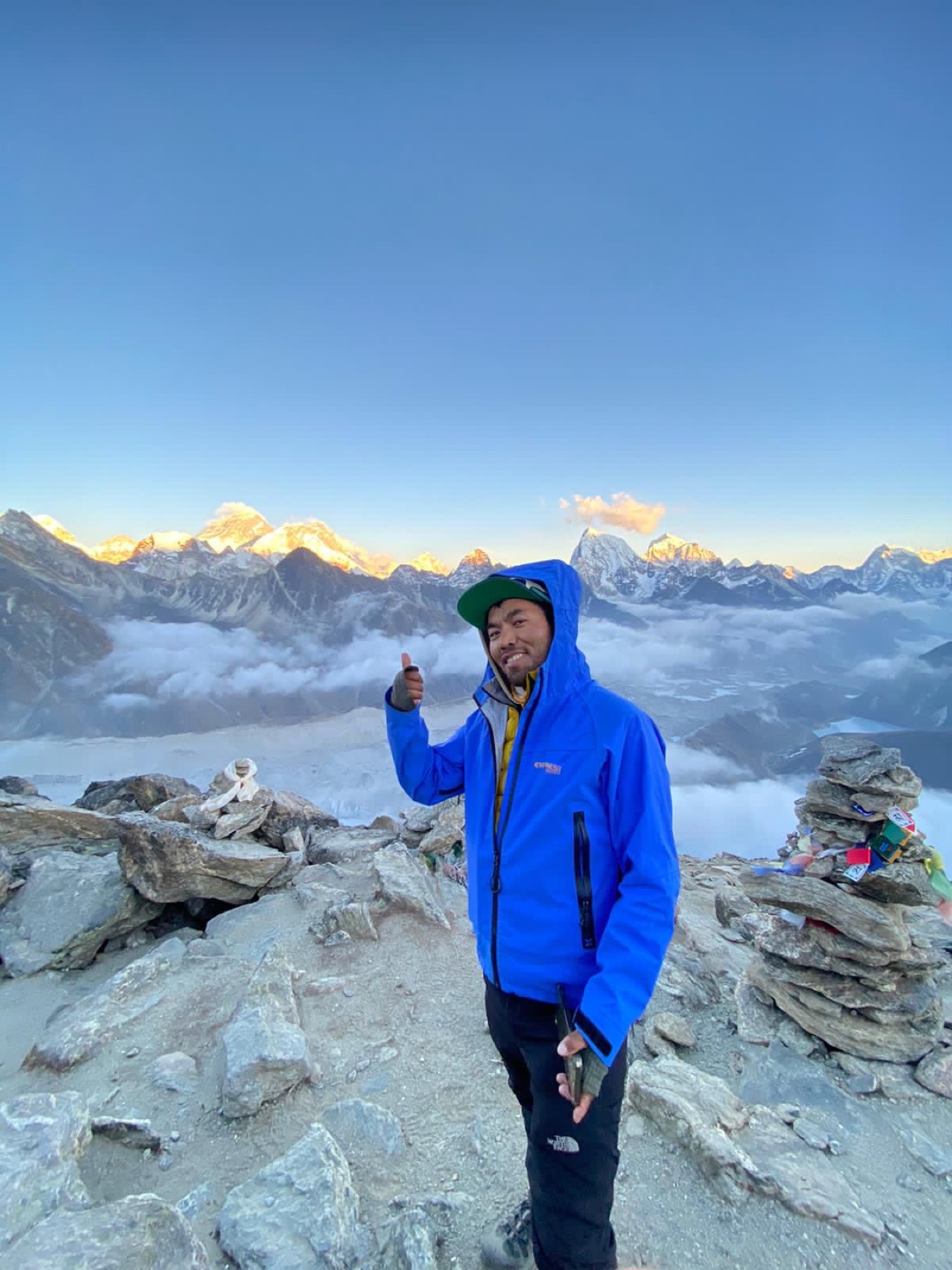
Fifteen days is long enough that you stop performing. That is the whole point.
Someone recommended it to me.
After that everything went very fast
Anna G. had travelled in Nepal with Amrit a few years earlier. She told me about it and made the introduction, and that was all it took. Two phone calls later I was there.
I am grateful to her for it to this day. That journey changed how I live, and it is the reason for what I do today.
I was outrageously lucky: I was the only guest. No group, no programme for twenty people. Only the path and Dawa, my guide. I left my comfort zone several times in those days, and not by a little.
Dawa is a close friend today.
That journey turned my life upside down. Entirely for the better. And I am still living off it today, every single day.
That is exactly what made me offer it. For people who have been carrying far too much weight through life for far too long.
I have been there myself, on foot, for weeks. Which is why this journey does not come out of a catalogue. We built it together, Himalayan Quests and I, for exactly this group and for exactly what it is meant to do to a person.
What nobody expects is the people. The kindness you are met with there is hard to describe without sounding sentimental. People who have little and give a lot. When someone asks me about Nepal, I have not talked about the mountains for years.
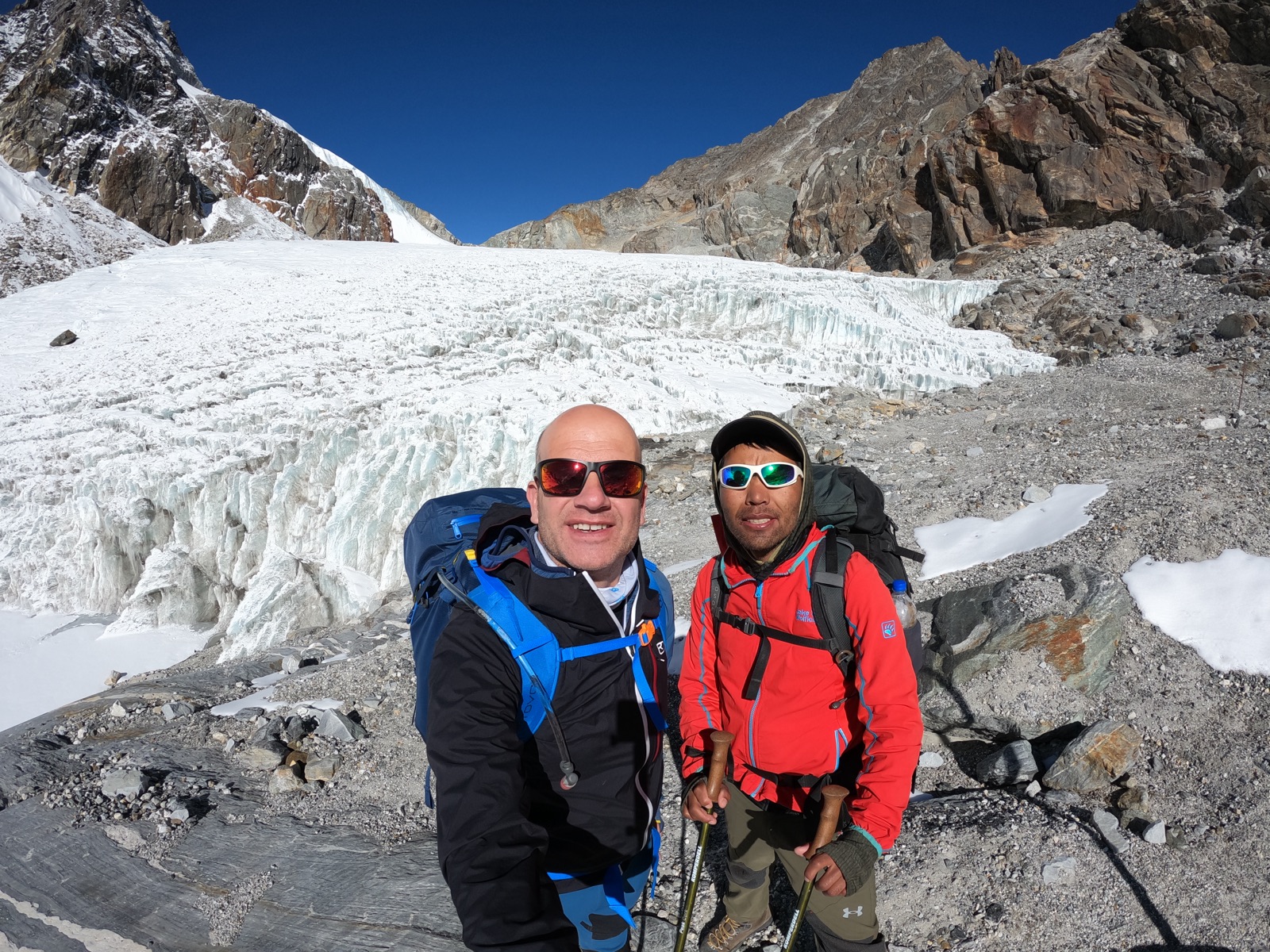
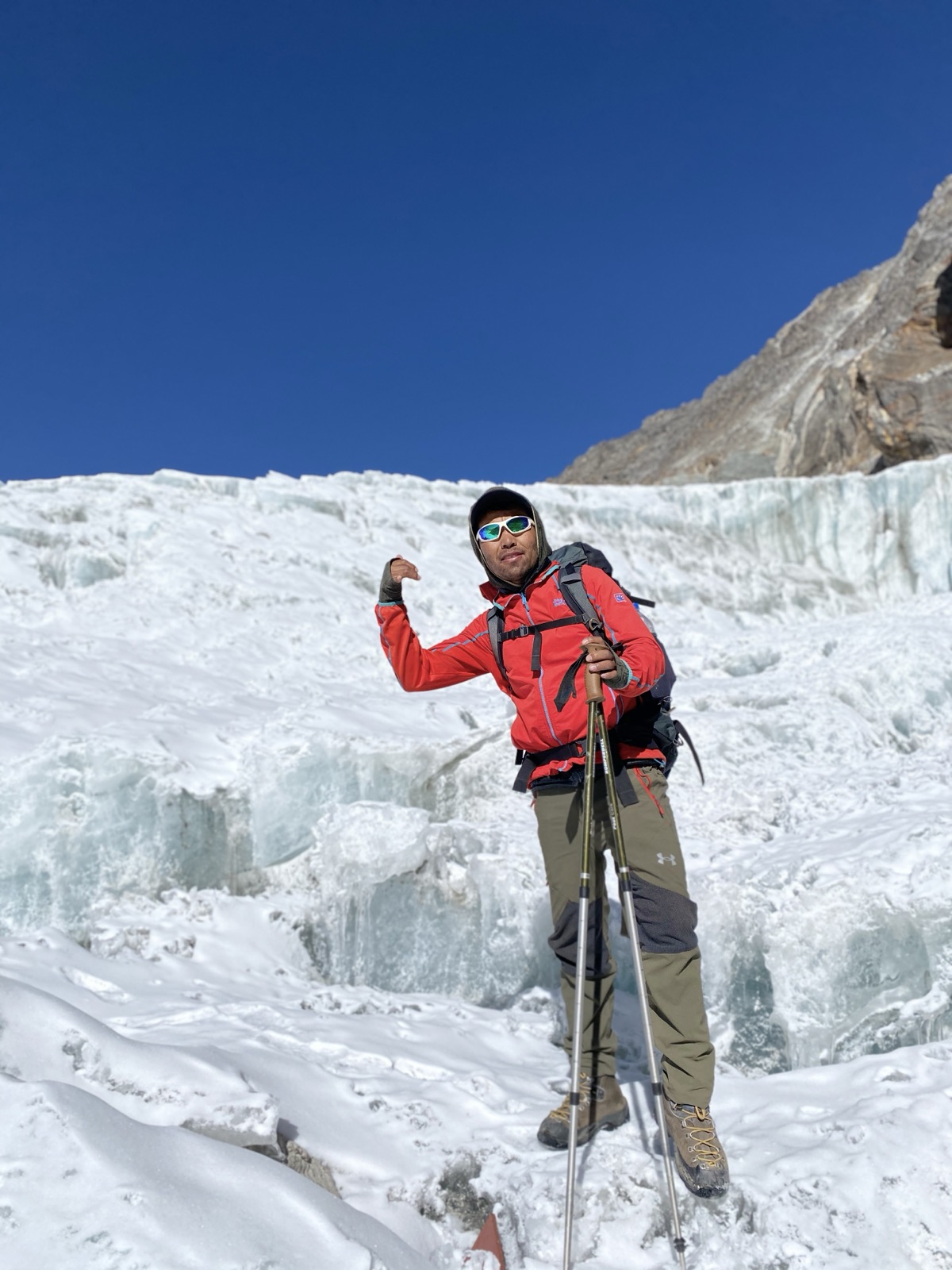
2021, on the way to Everest Base Camp. Those days became the friendship this journey grew out of.
Two projects. And two days on foot to carry the material up there
Every Quest to Purpose includes a community project. This is not a photo opportunity bolted onto a trekking trip. It is three full days, and you are there as a pair of hands, not as a visitor.
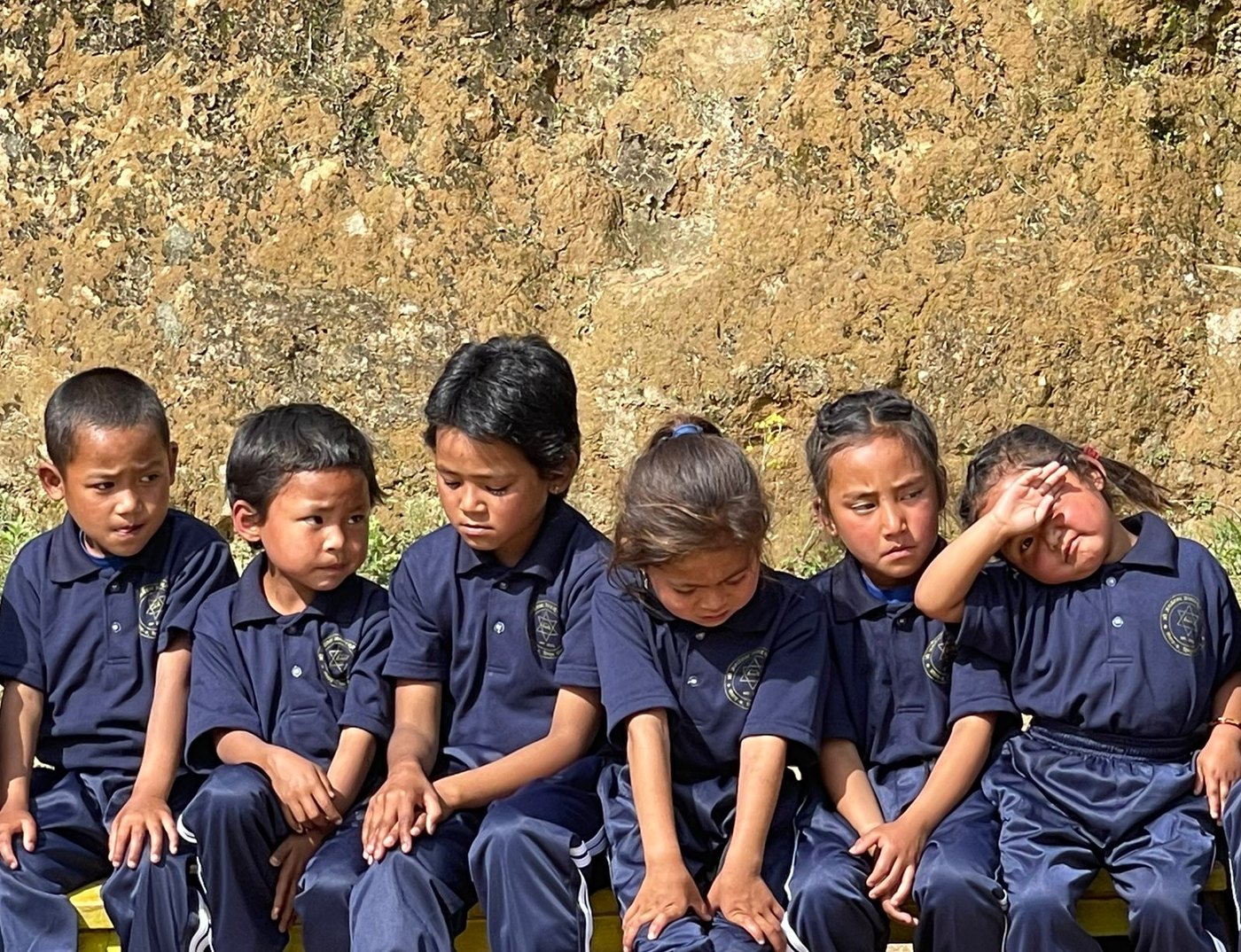
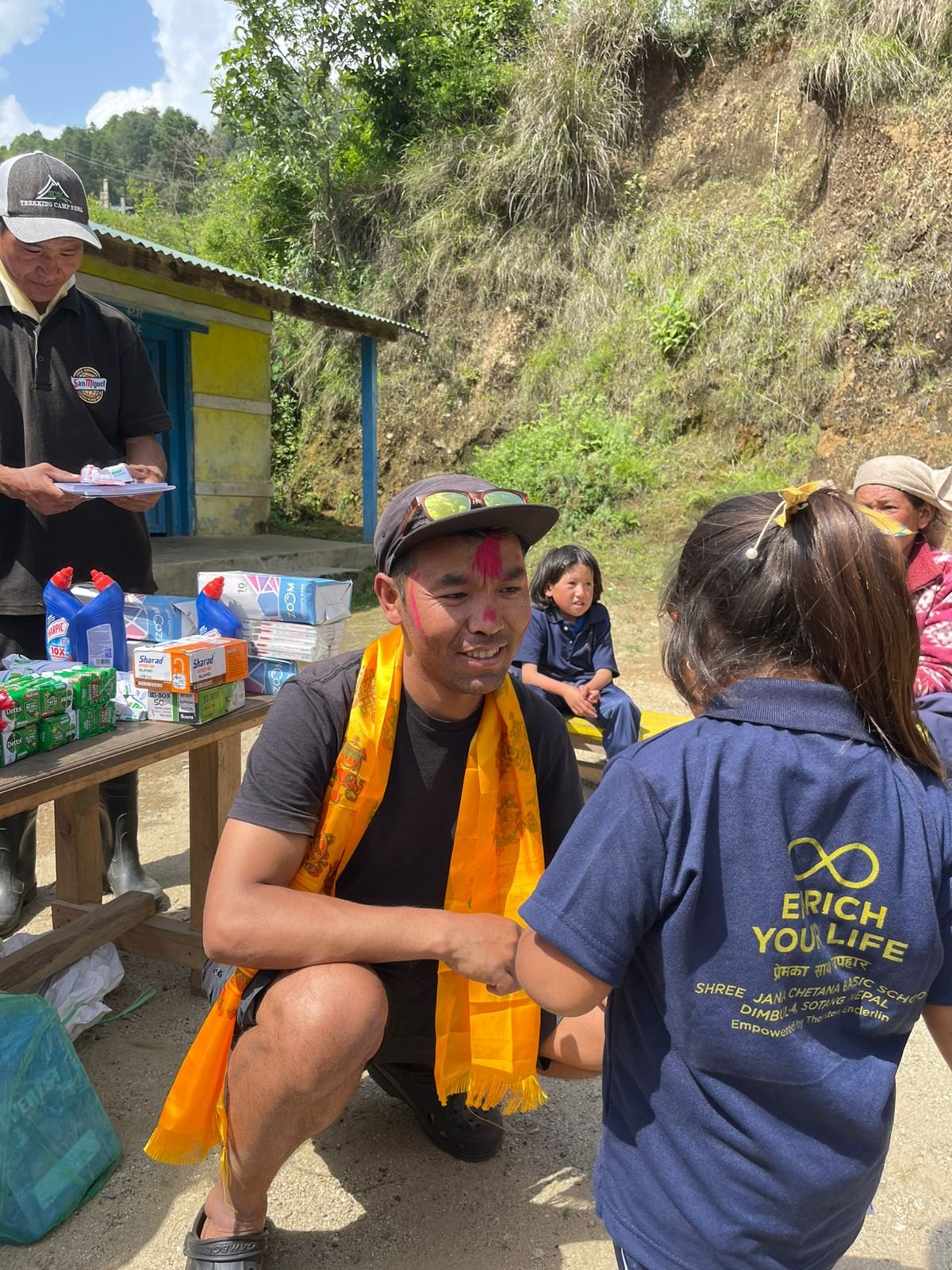
The school in Sotang
Shree Jana Chetana Basic School in Dimbul-4, Sotang. Uniforms for the children, plus school materials and hygiene items. The uniform says Enrich your Life and, in Nepali, a gift with love.
We support the school continuously, not just once.
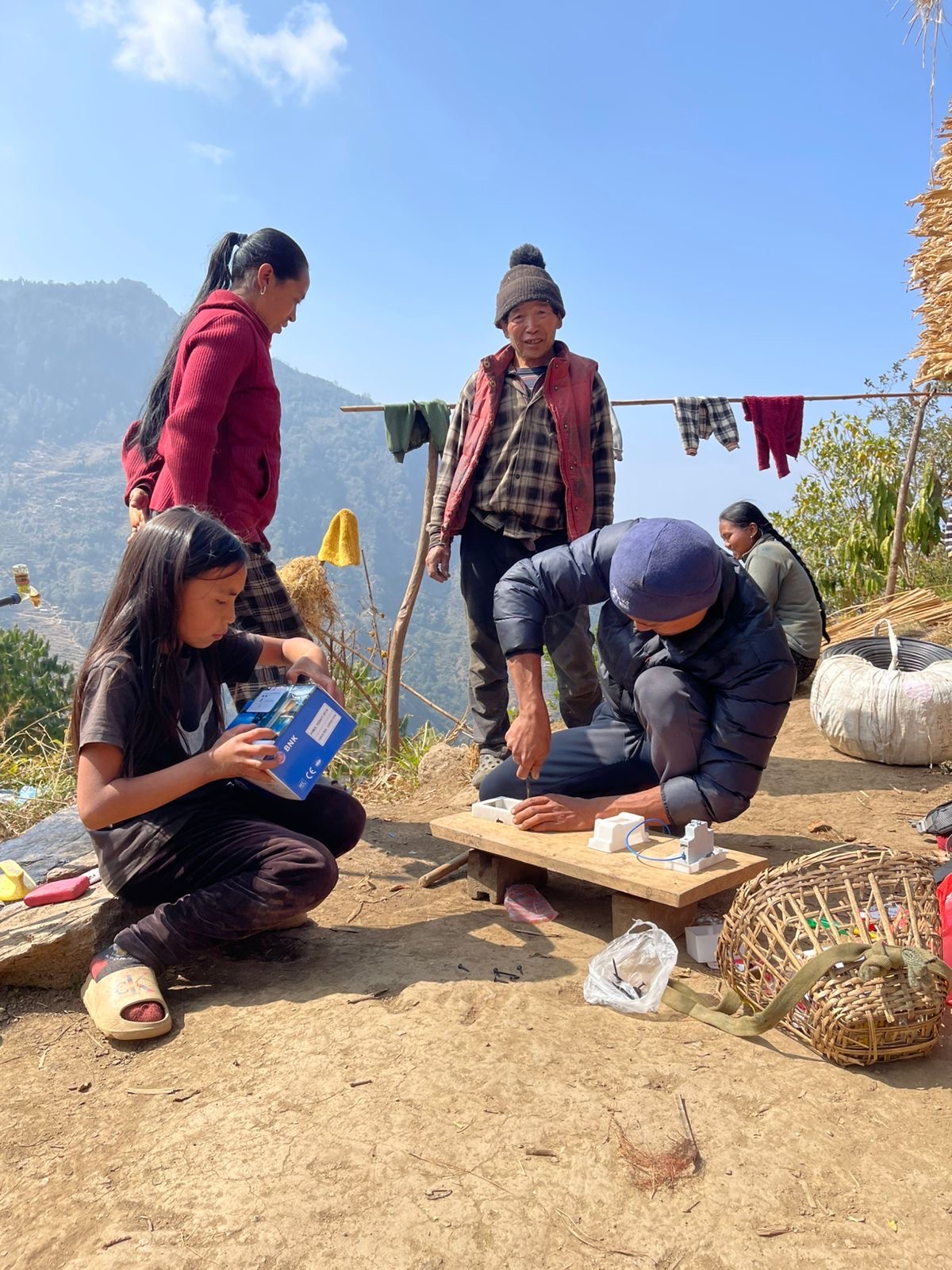
Power and light for the families
Six houses in Dimbul now have power and light. For the first time there is light in the evening once the sun is gone.
The girl in the photograph is holding the switches in her hand. Before that there was no wall for them.
For both projects, people walked through the mountains for two days and carried the material up on their backs. There is no road up there. There are only people who walk.
The joy, the gratitude and the appreciation you meet there are hard to describe. That is exactly the point.
864.00 EUR from every place. Not into a reserve, not into a budget that turns into something one day. Into the project we do that year.
With ten participants that is exactly 8,640 EUR in a village where a school uniform costs fourteen euros and connecting a house costs two hundred and fifty. Which project it will be in 2027 is something Dawa and I decide shortly before the journey, based on what is actually needed then. Afterwards you get to see what came of it.
Fifteen days, in order
Arrive in Kathmandu, transfer to the hotel, and a first evening together with a welcome drink.
Orientation. Asan Bazaar in the afternoon, then Swayambhunath, the Monkey Temple, at dusk. You walk a kora with the pilgrims. Walking meditation, whether you call it that or not.
Transfer to the project village. You meet your host family and the work begins. First night in their house.
A full day on the project. Second night with the family.
Finish the project and leave after lunch. Pashupatinath in the afternoon, where you meet the sadhus, then Boudhanath and another kora. Dinner overlooking the stupa.
The trek begins. Five hours by road to the trailhead at Chipling. First teahouse, and the first evening with nothing to answer.
Six hours through forest and terraced fields, past small Tamang settlements. The whole day is walked in silence. No talking, no eye contact. At the end there is a circle where people share, and that is what the whole day builds up to.
Up through rhododendron and fir until the forest opens into alpine meadow. In the evening, a sound bowl session in the teahouse.
Along the ridgeline to Tharepathi, the high point of the walk, with the Langtang, Gosaikunda and Everest ranges open in front of you. In the evening, at a firepit, you write down what you have been carrying and burn it.
A sharp descent through pine and bamboo to Melamchigyang, a Yolmo village of terraced fields and monasteries. Your last night on the trail.
A short walk to Nakote, then the drive back to Kathmandu. A bed, a shower, and a very different evening.
Nothing. A free day in Kathmandu, on purpose.
The monastery. Puja with the monks before breakfast, teaching, meditation, and the final individual work. Evening puja to close each day.
Transfer to the airport. There is not much talking on this morning.
From the years before
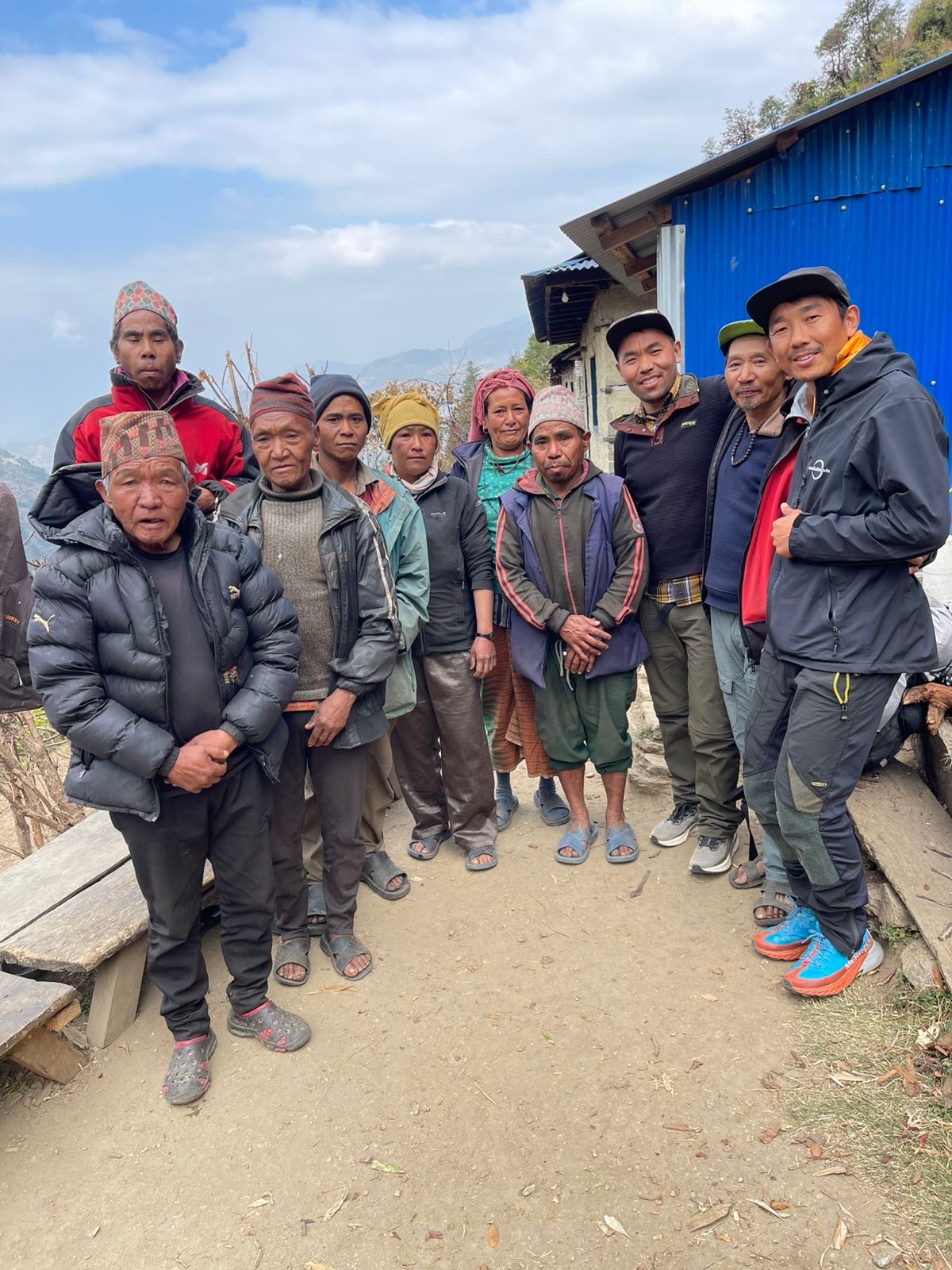
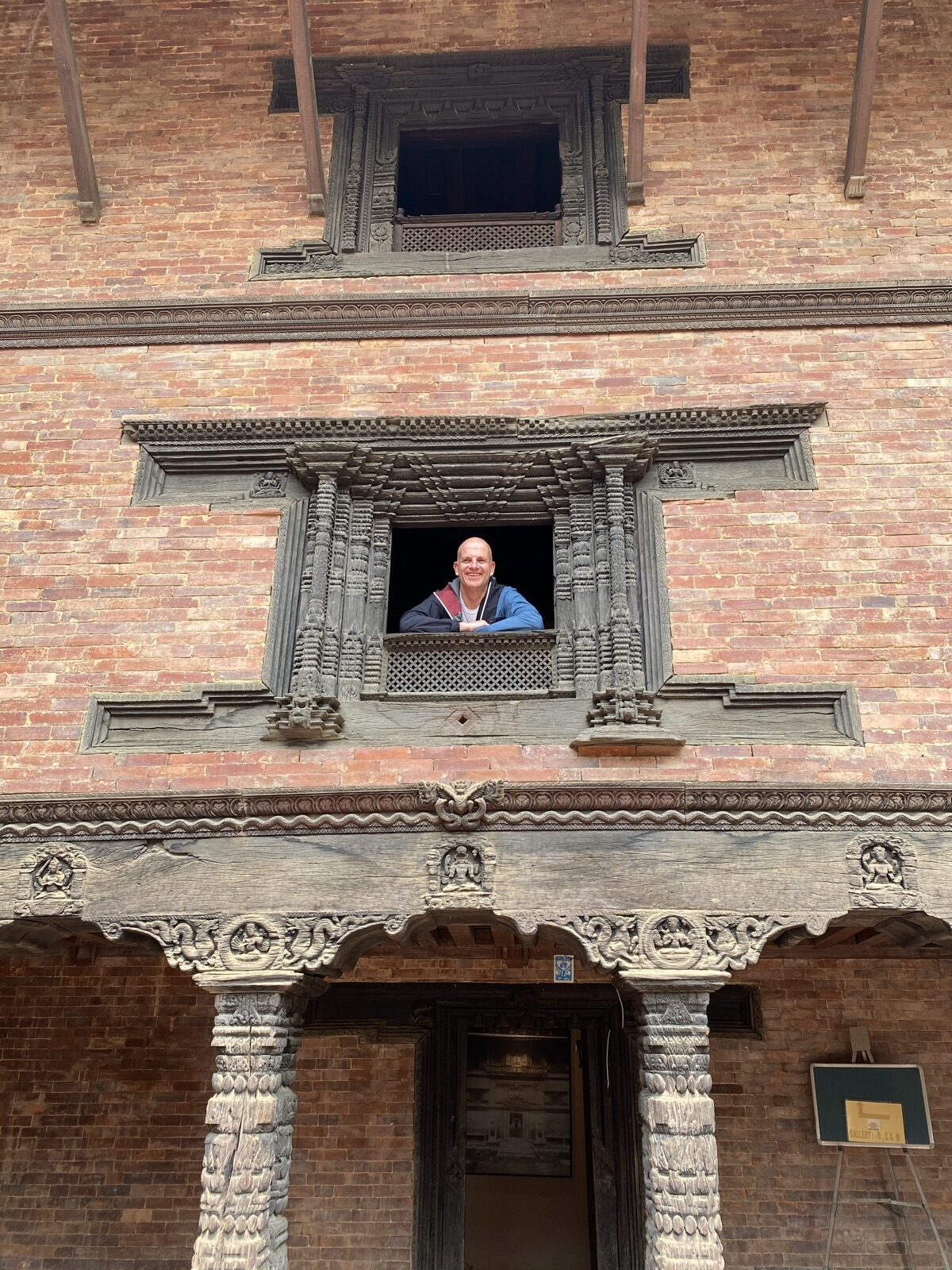
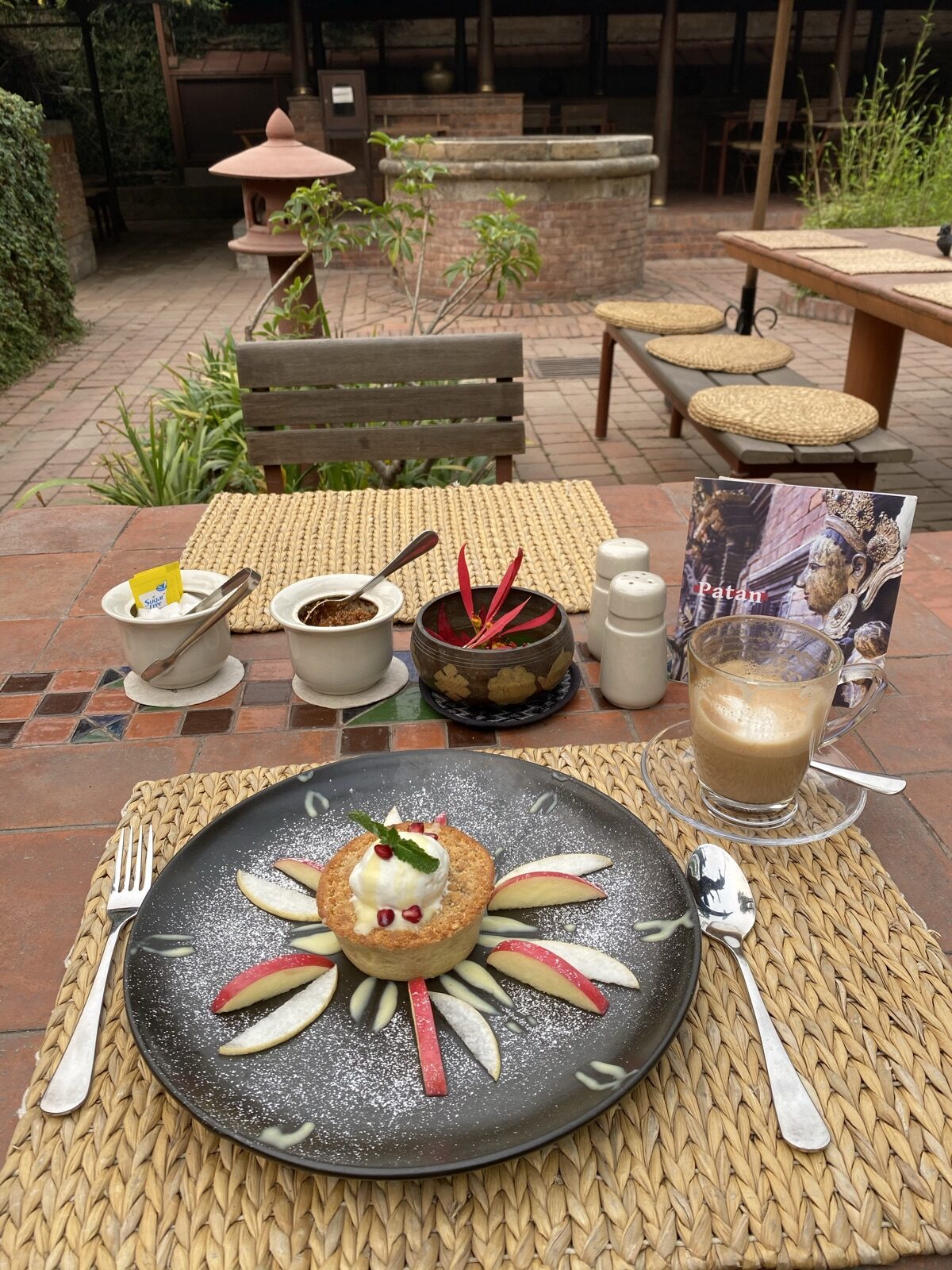
No stock photography. These are Nepal pictures from my own trips, from the trek with Dawa and from the projects in the village.
What is included, and what is not
From the airport in Kathmandu onwards you are taken care of. And yes, on the way we sleep in simple teahouses and not in hotels. That is not a saving, that is how it works. A hotel room gives you back exactly what you came away from: a door you can close and be your old self in your role again.
Included in the price
- Advice and all documents before the journey
- Two one to one sessions with me, sixty minutes each, one before and one after the journey
- Me with you on every single day on the ground
- All transfers in Nepal, from and to Kathmandu airport
- Fourteen nights: five nights in a hotel in Kathmandu, two nights with the host family, five nights in teahouses, two nights in the monastery guesthouse
- Full board on the trail, with tea and coffee at meals
- Almost all meals in Kathmandu, listed day by day
- The complete trek with local guides and porters
- All permits, national park and entrance fees
- Insurance and equipment for the Nepali team
- Group medical kit and rescue cover on the ground
- The community project, three full days
- Ten per cent of the trip price for the school and the projects on the ground
- Lifetime access to the group that walked with you
Not included
- Your flight to Kathmandu and back
- Visa for Nepal
- Travel insurance. Mountain rescue and repatriation are mandatory, and the cover has to reach 4,000 metres
- Tips
- Souvenirs
- Alcoholic drinks
- Personal extras on the way: sweets, drinks outside meals, hot showers, charging your devices
- Meals that are not listed in the day by day plan
- Single room supplement in Kathmandu and at the monastery if you want to sleep alone
- Costs caused by delays that none of us can influence
You do not need to buy an outfit. You can hire a backpack and a down jacket from our partner in Kathmandu. And no, you do not need mountain experience. We do not climb and we do not scramble. We walk. If you can manage a day hike in the Black Forest or the Alpine foothills, you can manage this.
Not a mountain. A path
You do not need mountain experience. We do not climb and we do not scramble. We walk. These are paths like the ones you know from home, only longer and a little higher. If you can manage a day hike in the Black Forest or the Alpine foothills, you can manage this. Porters carry your main luggage, you walk with a daypack.
Chipling to Kutumsang, 2,470 metres, around six hours.
Kutumsang to Magangoth, 3,300 metres, around four hours.
Magangoth to Tharepathi, 3,600 metres, around four hours. The highest point of the journey.
Tharepathi to Melamchigyang, 2,530 metres, around six hours.
Down to Nakote, 2,000 metres, around two hours.
You never sleep higher than 3,300 metres. Even so, this belongs here: altitude sickness can affect anyone from around 3,000 metres, regardless of fitness or age, in Nepal just as in the Alps. The German Federal Foreign Office expressly recommends medical advice before high mountain trips. If you have any pre-existing conditions, speak to your doctor beforehand.
Passport, visa, vaccinations
Your passport has to be valid for at least six months on entry, and an identity card is not enough. You get the visa on arrival at Kathmandu airport from a terminal, or in advance from the Nepali embassy in Berlin. Take the thirty day version, the journey lasts fifteen days and your flights come on top of that.
On vaccinations, the German Federal Foreign Office recommends keeping your standard vaccinations up to date, plus hepatitis A and typhoid. What applies to you is something you decide with your doctor, ideally at a travel medicine consultation and at least six weeks before departure. Malaria is not an issue in Kathmandu or above 2,500 metres.
Travel insurance with mountain rescue and repatriation up to 4,000 metres is mandatory. Trip cancellation insurance is not, and I still recommend it: you book around a year in advance, and it covers exactly the cases that would otherwise cost you dearly. All details without guarantee, what counts are the travel and safety notices of the German Federal Foreign Office at the time of your journey.
Who this is for
It is for you if
- you function on the outside and have been carrying something inside for years that nobody sees
- your calendar is full and you still could not say what for
- you have achieved everything you set out to achieve and none of it feels the way you thought it would
- you have been putting off a decision ever since you first thought it
- you are willing to live uncomfortably for two weeks because you suspect that is exactly what it takes
- you want to meet people who get to know you before they know what you do for a living
It is not for you if
- you are looking for a holiday. This is not one
- you want a method to take home and work through
- you expect someone to hand you the answer
- you have to stay reachable in between
- you want to avoid the uncomfortable part. That is exactly where it happens
And in case you are wondering what to tell your board: You are taking three weeks to work on the question of how you want to lead for the next ten years. This is not a holiday. This is the work there is never room for in the calendar.
The journey is not new.
What is new is that I lead it
This journey does not exist anywhere else. I built it with Amrit and Kate, for exactly this group and for exactly what it is meant to do to a person. You cannot book it anywhere else, because it does not exist anywhere else.
Which also means you would be in the first group. For some people that is a reason not to come. For others it is exactly the reason.
I cannot show you voices of previous participants, because there are none yet. I could borrow some from elsewhere and put them next to it. I am not going to.
What does exist is everything else. I have been there myself, for weeks, on foot, with Dawa. I have sat with the families in the village and I have been in the schools. I have supported the school in Sotang since 2022, and Dawa and I organise the projects together. This is not a journey out of a catalogue. It is the place I have been coming and going from for years.
Ask me in our conversation everything you would otherwise look up in a review. And listen to episode 4, that is Amrit.
Fifteen days, fourteen nights, everything on the ground included. Without the flight, because you book your own flight best and usually cheapest.
So you do not have to work it out yourself: Flight, visa, insurance and personal extras come on top, reckon with around 1,500 euros. So you are at roughly 10,100 euros in total.
What is different afterwards
You know again what you spend your energy on and what you do not. You have made the decision you have been putting off for years, or you finally know why you are not making it. And you have tools with you that work on a Tuesday morning and not only on a mountain ridge.
Where the 8,640 euros go
Most of it goes to Nepal. Accommodation, food, guides, porters, permits, transport and safety on the ground make up around a quarter of the price. Ten per cent, that is 864.00 euros, stays in the community project. On top of that come insurance, the statutory customer money protection, taxes and my fee for fifteen days on the ground without a break, two one to one sessions, and the preparation and follow up.
The journey runs from six participants onwards. If that number is not reached I will cancel no later than thirty days before the journey starts, and within fourteen days you get back everything you have paid.
You get the payment plan, the travel terms and the security for your deposit in writing before you decide. None of it has to be decided on the call.
Four who matter
Thorsten Enderlin
Leadership and life coach. Over 20 years in a global corporation before this. He walks the whole route with you and is available for a conversation on any day of it, planned or not.
Dawa, your guide
Mountain guide from Solu Khumbu, from a Sherpa family. He leads the trek. We walked the route to Everest Base Camp together and have been friends ever since. Whatever projects happen in Nepal, happen with him.
Himalayan Quests
Amrit and Kate Ale, in Kathmandu. A Nepali company in Nepali hands, with its own non profit sister organisation. Amrit is an internationally certified outdoor educator. The route is theirs, built for this group. You cannot book it anywhere else, because it does not exist anywhere else.
You
Without you this is a hike. We can show you the way, hold the door and be there when it gets uncomfortable. Walking through it is yours to do. Whoever is ready gets fifteen days they will never give back. Whoever is not gets a strenuous trip.
Episode 4, with Amrit
Amrit Ale, our partner in Kathmandu, as a guest on my podcast. It is about walking, about Nepal, and about what happens to people when you take their familiar surroundings away. If you want to know whose hands you are putting yourself in, this is the shortest way.
Hike Your Way to a Lighter Life · in English · Spotify
One conversation,
thirty minutes
You tell me what is going on. Even if you cannot name it, and most of the time one cannot.
I tell you exactly what the fifteen days ask of you, and what they cost.
We both decide. Either of us can say no, and neither of us has to explain it away.
The packing list
We work in layers. Several thin layers on top of each other regulate body temperature better than one thick item, and they dry faster. Merino wool or synthetics, no cotton. You also get the list as a file once you are in. This is a guide, not a rule.
Upper body
Lower body
Backpack and sleeping bag
Footwear
Small things that make the difference
Questions people ask
I have never been trekking. Is this for me?
Yes. Five walking days, four to six hours, the last one only around two, on paths and not in technical terrain. The highest point is 3,600 metres. Fitness helps, willingness helps more. Most of what is hard on this journey is not the walking.
Why does it cost 8,640 euros?
Most of it goes to Nepal: accommodation, food, guides, porters, permits, transport and safety on the ground are around a quarter of the price. Eight hundred and sixty four euros stay in the community project. On top of that come insurance, customer money protection, taxes and my fee for fifteen days on the ground without a break, two one to one sessions and the preparation and follow up. What is not included is listed above, in full and with no small print.
Teahouses instead of a hotel. Is that not a step down for the price?
No, it is the point. A hotel room gives you a door you can close and function behind again. A teahouse takes exactly that away. Simple yes, improvised no: permits, mountain guiding, altitude profile, group medical kit and rescue cover are at a level that has nothing to do with the bed.
What makes this different from a normal trek?
There is something in every day. A day of silence on the trail. A singing bowl evening at 3,300 metres. A fire ceremony at the highest point where you burn what you no longer want to carry. You live with a family for three days, and you finish in a monastery and not at an airport bar. The route was built for this and deliberately runs away from the usual paths.
Do I need my own equipment?
Boots and clothing you can layer, yes. A backpack and a down jacket you can hire in Kathmandu. The full packing list is further up this page, long before you have to buy anything.
Do I come alone or can I bring someone?
Coming alone is the normal case, and it is part of it. You can also get in touch as a pair. You both have the same conversation.
What happens with the community project?
It is three full days of real work, chosen close to the date according to what is needed then. In the past that has meant school uniforms for a village school, and electricity and light for six houses in Dimbul Village. You are there as a pair of hands.
What if the group does not fill up?
The journey runs from six participants onwards. If we do not reach that number I will cancel no later than thirty days before the journey starts and within fourteen days you get everything back. Twelve is the upper limit, and it stays that way.
When are the exact dates fixed?
In early 2027, as soon as October is confirmed on the ground. If you like, I will put you down without obligation: you will hear the dates before they appear on this page, and you decide afterwards, in your own time. It costs nothing, commits you to nothing, and one line from you cancels it. Just say so in our conversation.
Who do I share a room with?
In Kathmandu and at the monastery you can sleep alone, there is a single room supplement for that. On the trek you share the teahouse room, usually two of you. Who shares with whom is agreed before the journey and not on the spot.
Am I reachable while I am away?
In Kathmandu and in the village, yes. On the trek, for five days, mostly not, and that is not an oversight, that is how it works. How you can be reached in an emergency and how your family reaches us is settled bindingly before the journey. Nobody sets off from here feeling unreachable if something happens at home.
What if I have to cancel?
You can withdraw at any time. Up to 185 days before the journey starts that costs you 500 euros. After that it rises in steps, because from then on my own payments to Nepal are running. You get the full scale in writing before you decide. That is exactly why this page recommends trip cancellation insurance: it covers the cases you do not want to think about right now.
Is my money safe?
Yes, and not because I say so. As a tour operator I am not allowed to take any money at all until the statutory customer money protection is in place and you are holding the security certificate. That is not goodwill, that is section 651t of the German Civil Code. Until then you can have a place put aside for you without paying a cent.
Which language?
English. This is an international journey, the group comes from several countries, and English is spoken on the ground. If your English is rusty, that is not an obstacle: I am there every single day, from start to finish, and I translate wherever it is needed. Your two one to one sessions before and after are in German if you prefer.
Fifteen days is too much right now?
Aus.Zeit is a long weekend in the Black Forest, in May 2027. Have a look.